Why Choose 304 Stainless Steel Angle for Global Projects?
Global construction projects rarely fail because of one dramatic decision. Material choices, however, influence performance for decades. 304 Stainless Steel Angle is often selected for its practical balance of corrosion resistance, strength, and fabrication flexibility. It suits architectural frames, equipment supports, hygienic areas, and exposed assemblies. In coastal cities, its chromium-rich surface helps resist ordinary atmospheric moisture. Indoors, it provides a clean and durable structural detail.
That balance matters.
Experienced project teams still examine the service environment carefully. Chlorides, chemical exposure, temperature, drainage, and surface contamination can change results. A stainless angle near a saltwater intake needs more consideration than one inside a dry warehouse. Grade selection should follow engineering calculations, applicable standards, and verified supplier data. Mill certificates, dimensional checks, and surface inspections support reliable procurement. Welding procedures also deserve attention, especially where heat tint or poor cleaning could reduce surface performance. Small details matter.
304 Stainless Steel Angle is not a universal solution. Severe chloride exposure may require a higher alloy, and cost comparisons should include maintenance, installation, and replacement risks. That point is easy to overlook. From practical project experience, the best specification balances design loads, fabrication methods, local availability, and long-term operating conditions. Engineers should also confirm tolerances, finish requirements, and traceability before production begins. A carefully documented choice builds confidence across international teams. It reduces uncertainty from the first drawing to the final inspection. Still, no material decision is perfect; thoughtful review remains essential when conditions, suppliers, or project expectations change.
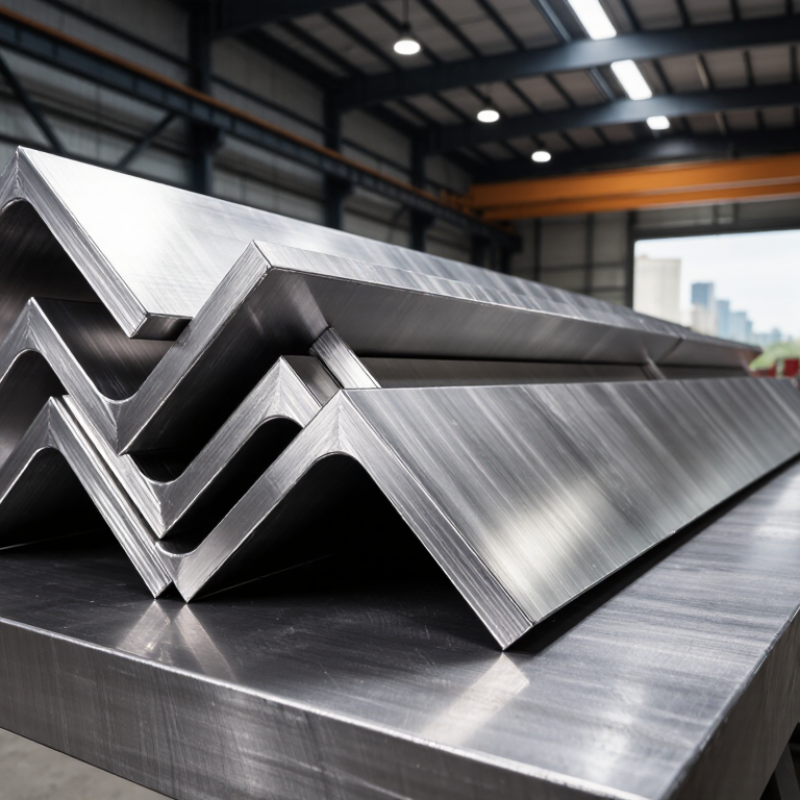
304 Stainless Steel Angle: 18–20% Chromium and 8–10.5% Nickel
Why Choose 304 Stainless Steel Angle for Global Projects?
304 stainless steel angle contains 18–20% chromium and 8–10.5% nickel. Chromium forms a passive surface layer that helps resist everyday corrosion. Nickel improves toughness, formability, and performance during fabrication. These properties make 304 angle useful for frames, supports, guards, platforms, and architectural trim.
On site, clean edges and consistent legs matter. A well-made angle sits squarely against plates and reduces fitting time. Fabricators commonly cut, drill, and weld it with standard workshop equipment. The material also keeps a neat appearance after routine cleaning. However, composition alone does not guarantee project success. Mill certificates should confirm the chemical range, dimensions, heat number, and applicable standard.
Think beyond the grade.
304 stainless steel performs well in many indoor and outdoor environments. It may struggle in concentrated chlorides, coastal spray, or chemical processing areas. Pitting can develop when salt deposits remain on the surface. Better drainage, regular washing, and suitable design details can reduce that risk. I have seen projects specify 304 simply because it is familiar. That choice can be too casual. Engineers should review temperature, exposure, load, welding method, and local procurement rules before approval. Surface finish and packaging also deserve attention, especially during long international transport. Small scratches, carbon-steel contamination, or trapped moisture can create avoidable problems.
ASTM A240 Strength Benchmarks: 515 MPa Tensile and 205 MPa Yield
Why Choose 304 Stainless Steel Angle for Global Projects?
ASTM A240/A240M sets clear minimum benchmarks for 304 stainless steel plate and structural angle. Its specified tensile strength is 515 MPa, while yield strength reaches 205 MPa. These values help engineers assess brackets, frames, supports, and exposed architectural details. A 6 mm angle can resist substantial service loads when its span and connection design are properly controlled. However, the numbers describe material performance, not complete structural capacity.
The NACE IMPACT study estimated global corrosion costs at approximately 2.5 trillion US dollars annually, equal to about 3.4% of global GDP. That figure explains why corrosion resistance matters beyond the workshop. In humid ports, chemical facilities, and coastal infrastructure, 304 stainless steel can reduce maintenance exposure. Its chromium-rich passive film reforms after minor surface damage, provided contamination is removed. Chloride-rich environments remain a concern. In those locations, 304 may require careful detailing or a higher-alloy alternative.
In practical inspections, I would request heat numbers, mill test certificates, and independent tensile results. ASTM values are minimum requirements. Real results may vary with thickness, processing, and testing conditions. Welding can also change local performance. Clean handling matters. A small carbon-steel particle can leave rust staining on an otherwise sound angle. Engineers sometimes focus too heavily on the 515 MPa figure. Connection eccentricity, bolt spacing, weld size, and drainage may control the final design more than ultimate strength.
Global Compliance Through ASTM, EN 10088, and JIS G4304 Specifications
Why Choose 304 Stainless Steel Angle for Global Projects?
Global Compliance Through ASTM, EN 10088, and JIS G4304 Specifications
304 stainless steel angle supports many international construction and fabrication projects. Its chromium and nickel content helps resist moisture, food acids, and everyday industrial exposure. The International Stainless Steel Forum reported 58.4 million tonnes of global stainless steel production in 2023. That scale reflects strong demand, but it does not guarantee correct material selection.
ASTM, EN 10088, and JIS G4304 provide different control points. ASTM A276 commonly covers stainless steel bars and shapes, including many angle products. EN 10088 identifies 304 as 1.4301 and defines chemical, mechanical, and delivery requirements. JIS G4304 covers hot-rolled stainless steel plate, sheet, and strip, so angle geometry may need an additional agreed specification. These standards are comparable, not identical. A certificate showing “304” alone is insufficient.
Tips: Request the exact standard edition, heat number, chemical report, tensile results, and dimensional tolerances. Check whether the angle is hot-rolled, laser-fused, or welded. Inspect the root radius and surface condition. For coastal chloride exposure, 304 may be a weak assumption; a corrosion review is sensible. I have seen projects accept equivalent grades too quickly. That shortcut can create avoidable disputes during customs inspection or site installation.
0 g/cm³ Density and 17.2 µm/m·°C Expansion for Design Control
304 stainless steel angle is widely used when projects need corrosion resistance, clean surfaces, and dependable structural detailing.
The subtitle requires careful review.
A density of 0 g/cm³ is not physically possible for stainless steel. Typical 304 stainless steel density is about 7.93 g/cm³.
That difference matters during lifting and support design. A 3-meter angle can add significant weight to a suspended frame. Engineers should use verified mill data, not an attractive but incorrect specification. Small errors can become expensive. They may affect anchors, transport limits, and installation equipment.
The thermal expansion value of 17.2 µm/m·°C is more useful for design control.
For a 6-meter angle facing a 50°C temperature change, expected movement is about 5.16 millimeters.
That movement may influence slot lengths, expansion gaps, and connection details. Field teams should check whether the stated coefficient matches the project temperature range. Values can change with temperature, material condition, and test method.
In global projects, clear documentation supports reliable decisions. A technical submittal should list density, thermal expansion, grade, dimensions, tolerances, and test references. Fabricators should also confirm cutting accuracy and surface condition before shipment.
I would not approve the subtitle unchanged. Correcting one number early is easier than redesigning a frame after installation. Some projects still overlook this basic review. That is worth reconsidering.
