Industrial suction hose selection is becoming more important as factories handle heavier materials, harsher chemicals, and tighter production schedules. MarketsandMarkets estimates that the global industrial hose market will grow steadily through 2029, driven by manufacturing, mining, construction, and oil and gas applications. This expansion reflects a practical reality: hose failure can interrupt production, damage equipment, and expose workers to dust, liquids, or flying debris.
A reliable suction hose must match the material, temperature, vacuum level, pressure, bend radius, and connection method. The wrong wall thickness may collapse under vacuum. Excessive bending can create hidden wear near fittings. Small details matter. The U.S. Occupational Safety and Health Administration emphasizes proper inspection, maintenance, and protection from mechanical damage during hose use. ISO 1307 also provides dimensional and tolerance guidance for rubber and plastics hoses, supporting more consistent purchasing decisions.
This guide reviews 10 best suction hose options for industrial use, comparing construction, flexibility, abrasion resistance, chemical compatibility, and service conditions. It considers reinforced PVC, rubber, polyurethane, food-grade, and heavy-duty designs. The ranking is useful, but not universal. A hose that performs well in grain transfer may fail quickly in abrasive mining slurry. That gap deserves attention. Product descriptions can also overlook coupling quality, storage temperature, and real vacuum performance. Therefore, each option should be checked against manufacturer test data, site measurements, and the actual material being transferred. Good selection is less about choosing the thickest hose. It is about choosing the safest match for a specific process.
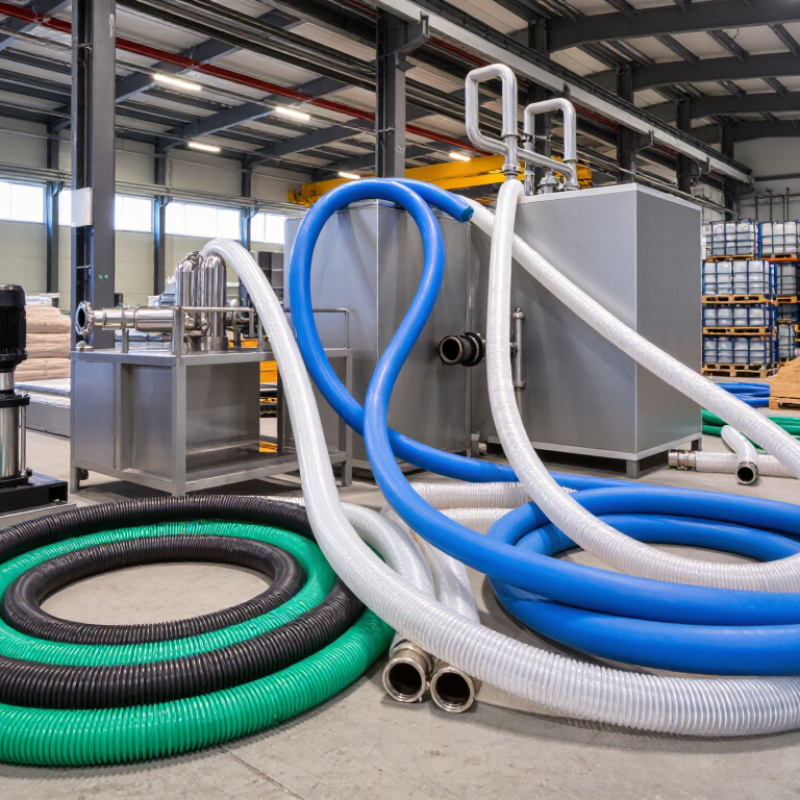
In industrial service, a suction hose does more than carry liquid. It must resist collapse while pumps create negative pressure. This separates suction lines from ordinary discharge hoses. The hose draws fluid from tanks, pits, drums, or process equipment. Its inner surface should remain smooth, reducing turbulence and pressure loss. A collapsed hose can stop production within minutes.
Its structure usually includes an inner tube, reinforcement layers, a spiral helix, and an outer cover. The helix may be made from rigid polymer or metal. It supports the wall during vacuum service and helps the hose keep its shape around bends. The inner tube must tolerate the fluid, while the cover withstands abrasion, sunlight, oil, or rough flooring. Couplings also matter. A strong hose can still fail through a loose or poorly matched connection. Look closely.
Operating performance depends on vacuum rating, temperature, flow rate, and bend radius. A thicker hose is not automatically safer. It may resist crushing but become difficult to position, increasing stress near the fittings. Before choosing among the ten best suction hose options for industrial use, check the pump’s vacuum demand and the fluid’s chemical properties. During inspections, look for soft spots, exposed reinforcement, cracks, and flattened sections. Keep the hose supported, avoid sharp bends, and never exceed its rated conditions. Real installations are rarely perfect, so records should include wear patterns and recurring connection problems.
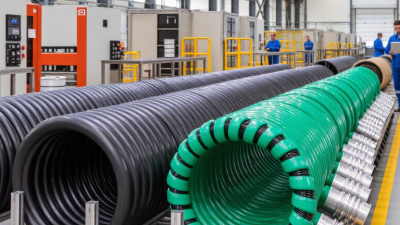
Choosing among ten industrial suction hose options starts with the material being moved. Dry powders, water, oils, and abrasive slurry impose different demands. I inspect temperature, pressure, vacuum level, and particle size before comparing products. A hose may look strong yet collapse under continuous suction. That failure can stop a transfer line within minutes. The inner wall matters, too. Smooth walls reduce buildup, while corrugated designs usually bend more easily.
Reinforcement deserves close attention. Helical wire, textile layers, or rigid ribs help resist crushing and kinking. Select a hose with a working vacuum rating above the equipment’s maximum demand. Leave a safety margin for startup surges and changing temperatures. Do not confuse pressure rating with suction performance. They measure different stresses. Connection size must match the coupling, pump inlet, and flow requirement. A narrow fitting can restrict flow and create unexpected losses. I have learned that “universal” sizing often hides expensive adaptation work.
Check chemical compatibility using actual concentration and operating temperature, not general labels. Consider static-control requirements where dry materials create friction. Grounding paths should be verified during installation and maintenance. Bend radius, hose length, weight, and storage space affect daily handling. A heavier hose may last longer, but workers may drag or sharply bend it. That is a practical weakness. Inspect for soft spots, exposed reinforcement, and loose couplings on a scheduled basis. Record these findings.
Industrial suction hose selection depends on the material, temperature, vacuum level, and cleaning method. In field inspections, the wrong hose often shows damage at bends and couplings first. A practical shortlist includes food-grade hose for powders, chemical-resistant hose for corrosive liquids, oil-resistant hose for petroleum fluids, and abrasion-resistant hose for sand or cement. Wire-reinforced hose supports stronger vacuum service, while crush-resistant hose suits busy factory floors. Smooth-bore hose reduces product buildup. Flexible lightweight hose improves operator handling. Anti-static hose helps control static charge, and high-temperature hose serves hot air or heated materials. Ten options, but no universal winner.
Safety data should guide the choice. The Occupational Safety and Health Administration limits respirable crystalline silica exposure to 50 micrograms per cubic meter over an eight-hour shift. Therefore, dust-transfer systems need sealed connections, suitable extraction, and hose interiors that resist clogging. The National Institute for Occupational Safety and Health also emphasizes controlling airborne contaminants at the source. Hose condition matters here. A small split can defeat an otherwise effective capture system.
Technical teams should check pressure ratings, bend radius, grounding continuity, and compatibility charts before installation. ISO 4649 abrasion testing can help compare rubber compounds, although laboratory results do not perfectly predict plant conditions. That limitation deserves attention. Inspect hoses weekly, especially near elbows, clamps, and suction inlets. Replace crushed sections early. It is cheaper than guessing. A clear application record also improves traceability, reliability, and maintenance decisions.
Industrial suction hoses must match the material, pressure, and working environment. Reinforced PVC is lightweight and flexible for water, mild chemicals, and general transfer. Rubber handles abrasion and repeated bending better. Thermoplastic rubber offers a useful balance between flexibility and wear resistance. Polyurethane resists oils, sharp particles, and internal abrasion. Silicone tolerates high temperatures, but it may perform poorly against heavy mechanical abuse. Composite hoses suit demanding chemical service when their lining matches the fluid.
Pressure ratings need careful reading. A suction hose requires a vacuum rating, not only a positive pressure rating. A hose can survive discharge pressure yet collapse during pumping. Check working pressure, burst pressure, vacuum resistance, temperature range, and coupling compatibility. Never select a hose from diameter alone. A narrow hose can increase flow resistance and reduce pump performance. Static grounding may also matter when transferring flammable liquids.
Durability depends on more than wall thickness. Look for embedded wire, spiral reinforcement, bend radius, cover texture, and resistance to sunlight or solvents. In field inspections, crushed sections often appear near clamps and sharp corners. Support those areas properly. I have seen an expensive hose fail early because operators dragged it across concrete. Clean the hose after abrasive service, and store it without tight bends. Ratings can change with heat, age, and repeated flexing. Manufacturer data remains essential, though real site conditions are rarely perfect. Testing a sample section before full installation is a sensible compromise.
Typical performance ranges are shown for industrial hose constructions and can vary by inside diameter, reinforcement, temperature, fittings, and manufacturer. Always confirm the exact hose specification before use.
| Rank | Hose Option | Primary Material and Construction | Typical Working Pressure | Typical Vacuum Rating | Typical Temperature Range | Approximate Minimum Bend Radius | Durability Profile | Best Industrial Applications |
|---|---|---|---|---|---|---|---|---|
| 1 | Heavy-Duty Rubber Material-Handling Suction Hose | Natural or synthetic rubber tube with textile and/or steel helix reinforcement | 10–20 bar (145–290 psi) | 0.8–0.9 bar vacuum | -30°C to +80°C (-22°F to +176°F) | Approximately 4–6 × hose inside diameter | Excellent abrasion, impact, and flex resistance; relatively heavy | Mining, cement, sand, gravel, slurry, and bulk-material transfer |
| 2 | Abrasion-Resistant Polyurethane Suction Hose | Polyurethane tube with embedded steel spiral or rigid polymer helix | 3–10 bar (44–145 psi) | 0.7–0.9 bar vacuum | -40°C to +90°C (-40°F to +194°F) | Approximately 3–6 × hose inside diameter | Very good resistance to abrasion, oils, and repeated flexing; lighter than rubber | Abrasive powders, plastic pellets, sawdust, granules, and dust collection |
| 3 | Flexible PVC Spiral Suction Hose | Soft PVC wall reinforced with a rigid PVC spiral | 1–5 bar (15–73 psi) | 0.6–0.9 bar vacuum | -20°C to +60°C (-4°F to +140°F) | Approximately 3–5 × hose inside diameter | Cost-effective and lightweight with good chemical resistance; less resistant to heat and heavy abrasion | Water, light chemicals, irrigation, drainage, and general-purpose suction |
| 4 | Oil-Resistant Nitrile Rubber Suction Hose | Nitrile rubber tube with textile reinforcement and an anti-crush spiral | 10–20 bar (145–290 psi) | 0.8–0.9 bar vacuum | -30°C to +100°C (-22°F to +212°F) | Approximately 4–6 × hose inside diameter | Strong resistance to petroleum oils, diesel, and lubricants; good mechanical durability | Fuel transfer, oil recovery, hydraulic-oil service, and lubrication systems |
| 5 | EPDM Chemical and Water Suction Hose | EPDM rubber tube with textile reinforcement and embedded helix | 10–16 bar (145–232 psi) | 0.8–0.9 bar vacuum | -40°C to +120°C (-40°F to +248°F) | Approximately 4–6 × hose inside diameter | Excellent weathering, ozone, hot-water, and many dilute-chemical resistance properties; unsuitable for most petroleum oils | Water treatment, chemical plants, acids, alkalis, and outdoor service |
| 6 | Food-Grade Thermoplastic Rubber Suction Hose | Food-contact thermoplastic elastomer with a smooth bore and reinforcing spiral | 4–10 bar (58–145 psi) | 0.7–0.9 bar vacuum | -40°C to +100°C (-40°F to +212°F) | Approximately 4–6 × hose inside diameter | Flexible, cleanable, and resistant to common cleaning agents; performance depends on sanitation temperature and chemistry | Dairy, beverage, food processing, pharmaceutical ingredients, and sanitary transfer |
| 7 | Silicone Suction Hose | Platinum- or peroxide-cured silicone with textile or wire reinforcement | 3–10 bar (44–145 psi) | 0.6–0.9 bar vacuum | -60°C to +180°C (-76°F to +356°F) | Approximately 4–8 × hose inside diameter | Excellent temperature flexibility and cleanliness; moderate tear and abrasion resistance | High-temperature food, pharmaceutical, laboratory, and clean-process applications |
| 8 | PTFE-Lined Chemical Suction Hose | Flexible PTFE inner tube with stainless-steel braid or spiral reinforcement | 10–20 bar (145–290 psi) | Typically 0.8–0.9 bar vacuum with suitable reinforcement | -60°C to +260°C (-76°F to +500°F) | Approximately 6–10 × hose inside diameter | Outstanding chemical resistance and high-temperature performance; comparatively stiff and costly | Aggressive chemicals, solvents, corrosive fluids, and high-purity processing |
| 9 | Composite Chemical and Fuel Suction Hose | Multiple thermoplastic films, textile layers, and an external helix | 10–16 bar (145–232 psi) | 0.8–0.9 bar vacuum | -30°C to +100°C (-22°F to +212°F) | Approximately 4–8 × hose inside diameter | Lightweight and flexible with good chemical and fuel resistance; outer cover requires protection from severe abrasion | Tank trucks, marine loading, chemical transfer, and fuel unloading |
| 10 | Stainless-Steel Corrugated Metal Suction Hose | Corrugated stainless-steel tube with braided stainless-steel reinforcement | 10–40 bar (145–580 psi), depending on size and braid | Up to full vacuum in appropriately designed assemblies | -200°C to +400°C (-328°F to +752°F), assembly-dependent | Approximately 6–12 × hose inside diameter | Excellent temperature, fire, pressure, and chemical resistance; requires careful handling to avoid kinking and fatigue | Steam, cryogenic fluids, hot gases, chemicals, and high-temperature industrial service |
Industrial suction hoses need correct installation before they need higher pressure ratings. Choose a hose with a reinforced wall, suitable vacuum rating, and chemical compatibility. The National Association for Hose and Accessories Distributors recommends checking hose assembly compatibility, bend radius, and coupling security during installation. Keep the hose supported, but avoid tight clamps that flatten its wall. A crushed section can collapse under vacuum.
Inspect the hose before every shift. Look for soft spots, exposed reinforcement, cuts, abrasion, and damaged couplings. Check clamps for movement and listen for air leaks near connections. The UK Health and Safety Executive recorded 561,000 non-fatal workplace injuries in Great Britain during 2023/24. This figure is not hose-specific, but it shows why small defects deserve attention. Do not rely on appearance alone.
Maintenance records should include inspection dates, operating fluid, vacuum level, and replacement reasons. Replace hoses after chemical swelling, repeated kinking, or visible reinforcement damage. Store them away from sunlight, heat, sharp edges, and oil contamination. Marking the flow direction helps prevent installation errors. It sounds basic.
Before startup, confirm that the suction line is fully connected and free from blockages. Never hold a leaking hose by hand while equipment operates. Stop the system, isolate energy sources, and release trapped vacuum before repairs. OSHA lockout/tagout guidance supports this control approach. A rushed inspection can miss hidden wall collapse, so the inspection checklist should be reviewed and improved after every near miss.
Typical maximum continuous service temperatures by hose material. Actual limits depend on construction, fluid compatibility, vacuum level, pressure, and manufacturer specifications.
Installation: use the correct diameter, keep the hose as short and straight as practical, prevent sharp bends, and secure couplings with suitable clamps. Maintenance: inspect before each use for cracks, flattening, abrasion, loose reinforcement, and damaged fittings; clean and dry the hose according to the conveyed material. Safety: confirm chemical compatibility, vacuum rating, temperature rating, and grounding requirements before operation. Never exceed the hose’s rated working conditions.